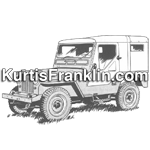
With the weather being nice and with the transmission cover already off the Jeep, I decided to do a little cleanup on some of the smaller pieces attached to the body. Along with the transmission cover, I removed the shift boot retaining rings for the transmission shifter as well as the transfer case shifting rods. While I was at it, I took off the master cylinder inspection plate, and then the eyelets and body-side door rails for the canvas top.
 On the passenger side, this proved especially problematic. The semi-veritcle rail on the left is mirrored on the passenger side. This rail holds the forward area of the canvas door, and the small eyelet further back is the hinge point. The hinge eyelets came off relatively easy with the hammer drill breaking the rusted screws loose. The driver side rail also came off without much trouble. The passenger side, however, took over an hour to get one bolt off.
A combination of rust, multiple paint jobs, and a weak cordless drill resulted in multiple failed attempts to free the rail from its 60 year imprisonment. After lots of work, two battery changes on the drill, and a back ache from the awkward position I was in, freed the rail. The good part about this whole thing is that I was finally able to verify the original factory color of Ike.
The previous owner had said that he thought the original color was probably yellow, underneath the copper and green color that is so easy to see everywhere on the vehicle. The first inclining that maybe yellow wasn’t the original color came when I cleaned the inside of the steel wheels and found bright red. In all the pictures I’ve seen, yellow jeeps usually had yellow or off-white wheels. I also noticed in some places where the green, copper, and yellow paint had chipped away, there was grey before the bare metal could be seen. Could grey be Ike’s original color?
 Along with that, I bought the CJ-3A book by Bob Westerman who takes a painstaking approach to detailing the nuances and changes made by Willys-Overland during the production of the 3A. Through a great deal of crawling around Ike and some help from Bob, we determined that my Jeep was likely built in Late July. The 3 colors that Willys-Overland were painting Jeeps that month was Emerald Green, Luzon Red, and … Potomac Grey. So, when the rails were removed and I saw this underneath, I think that pretty much confirms it.
So, that introduces an interesting and perplexing problem for me. When I didn’t know the original color, I was pretty much going to go with Normandy Blue as my body color. Then when I read that the colors made during the month my Jeep was built was green, grey, or red, I started leaning towards maybe going with grey or red. Now that I know it was originally grey, what color do I paint it?
I’m already making some non-stock modifications to it, for instance the inclusion of a second tail light, probably staying with the 12V conversion, and a few other minor changes. So going away from grey wouldn’t be that big of a deal overall. So now I have some decision to make. Below are some images of other owner’s CJ-3As in both red and grey.


With either color, I’d almost 100% go with black wheels. I’m not going for a museum piece, but just something mostly accurate.
Grey, black wheels.
That’s kinda what I was thinking, to be as original as possible. I’ve seen some really nice grey CJ-3A jeeps, and it certainly can look wonderful. I just don’t know if it will have the “wow” factor of a red Jeep, nor the visibility.
I like the grey, but I like the red also. I would have to see a paint sample of the colors up close and personal though. The three grey pictures are VERY different in color. Can you get a paint sample?
I like the ALL black wheels though!